


AquaINFRA News
What does it cost to clean up a sea, and can anyone prove the money works?
September 27th, 2026
An AquaINFRA use case looks at the Baltic, and finds that the hardest data to open is not the science, but the record of what we actually did about it.
For nearly forty years, the nine countries around the Baltic Sea have been counting what runs into it. Since 1987, the Baltic Marine Environment Protection Commission, better known as HELCOM, has compiled a running stocktake of nutrients reaching the sea from farms, cities, factories, and the air, now approaching its ninth edition. It is, by any measure, a serious piece of collective science.
"HELCOM has developed the most sophisticated and comprehensive system to collect data on the input of nutrients in Europe," says Dmitry Frank-Kamenetsky of HELCOM. "It also established the system for robust assessment of the Baltic Sea eutrophication status based on numerous observations and a set of indicators. It helped to raise awareness of the problem and identify policy goals."
That work has paid off. Nutrient inputs from point sources, such as sewage works, and from the air have fallen markedly. But the Baltic is not yet clean, and the AquaINFRA use case that Frank-Kamenetsky and his colleague Luke Dodd have been working on runs straight into the reason why. We know, in impressive detail, what goes into the sea. We know far less about whether the money and effort spent trying to reduce it is working.
The assumption that does not hold
AquaINFRA is built on a reasonable premise: that a great deal of environmental data already exists in digital form, and the problem is mostly one of visibility and access. Make it findable, and people can use it.
For monitoring, modelling and statistics, that holds. For the practical business of environmental management, Dodd argues, it does not.
"AquaINFRA largely builds from the assumption that digitised data exists, and the point of failure in its use is related to a lack of visibility or availability," he says. "However, this is really only true for environmental monitoring, modelling and statistical data. We are exploring how to catch practical environmental management up to the rest of AquaINFRA's topics."
Put plainly, it is one thing to measure how much nitrogen reaches the Gulf of Riga. It is quite another to find a usable record of which measures a country put in place to cut that nitrogen, what they cost, and whether they worked. Countries are legally obliged, under EU law, to weigh the cost-effectiveness of their environmental measures. The data behind those obligations is another matter.
Dodd has spent most of a decade on this problem, so the gaps were not a surprise to him. What was surprising was the distance between the confidence sometimes expressed around the HELCOM table and the reality on the ground.
"I don't think I am surprised that it doesn't exist," he says. "I think what has surprised me is the very large gap between the perception expressed within HELCOM at various moments that these data exist, and the national realities."
His diagnosis is uncomfortable. The EU rules that require consideration of cost-effectiveness don’t appear to be promoting any significant capacity building. "The reality is that a country needs a very sophisticated level of bureaucracy and environmental modelling in order to effectively develop these data." The use case focused on only two countries, Finland and Latvia, but Dodd's honest guess is broader: "I would guess that no country in the EU is currently prepared to deliver environmental management data at any significant scale." Finland, he thinks, is close and could become a major source if it chose to. "I don't believe the incentives are there at the moment."
What the search for the data actually looked like
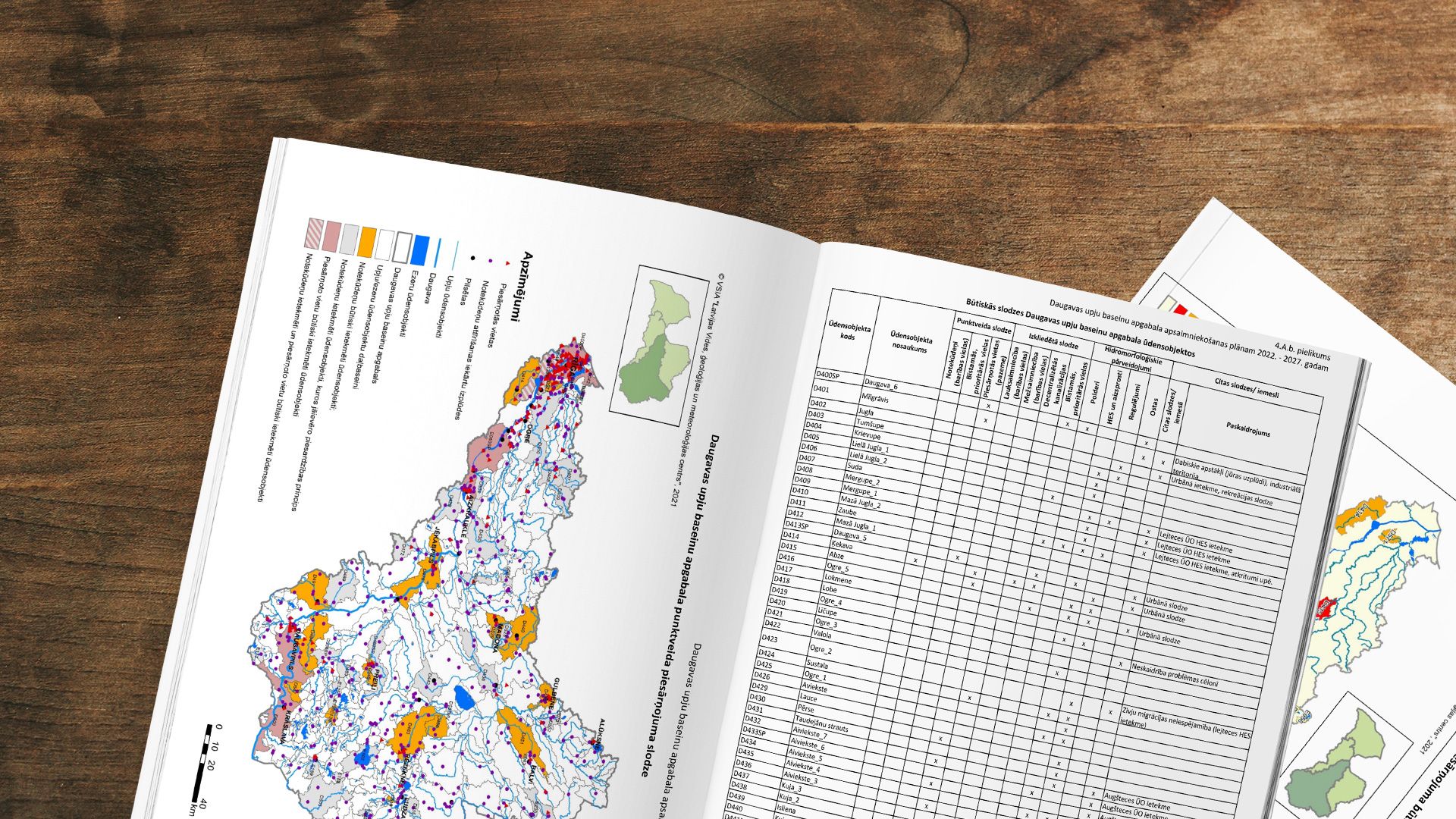
The Latvian half of the work shows what "locked away" means in practice, and it is not dramatic. It is a stack of PDFs.
Frank-Kamenetsky went looking for data on the effectiveness of planned measures, held in the river basin management plans that Latvia produces for the Daugava under the EU Water Framework Directive. The choice of the Daugava was not arbitrary: the first part of the use case had already shown that the greatest potential for cutting nutrient inputs lies in measures applied within river catchments.
"The data we were looking for were not accessible through any public interface," he says. "We studied numerous PDF files in the documentation for the Daugava plan, where measures and their anticipated effects were listed in the national language." He managed to extract some of it and link it back to the monitoring and assessment data from part one of the use case.
Then came the more revealing finding. Even when measures targeted the right sources of nutrients, their expected effect was small compared to what the sea actually needs.
"Despite the measures addressing key sources of nutrients, their anticipated effect was insignificant compared to the needed reduction," he says. The reason is a mismatch written into policy. Those catchment measures were never designed with the sea in mind. They exist to bring local rivers and lakes into good ecological status under the Water Framework Directive, not to meet the marine targets set by HELCOM and the EU Marine Strategy Framework Directive.
"This vast gap between marine policy and the Water Framework Directive seems to be the key obstacle in the development of programmes of measures with sufficient impact," Frank-Kamenetsky says. And on whether the listed measures were even carried out? "Information about the implementation of even those listed measures was completely missing."
Numbers to read carefully
The use case includes figures on the page, including an estimated cost per tonne of nitrogen and phosphorus removed from the Latvian Daugava. Frank-Kamenetsky is the first to caution against reading them as hard fact.
"This is not a robust assessment," he says. "The information is fragmented, and the analysis is missing a good number of parameters." Water retention along the river, for instance, was not worked through in detail.
The numbers show the shape of the problem. They illustrate that the Water Framework Directive measures do not address marine targets. They point to the relative cost-effectiveness of cutting nutrients from different sources. And, importantly, they show that a proper analysis is possible in principle. The team even set out a table of the parameters an analysis of this kind would need. The obstacle is not the arithmetic. It is the gap between the policies that generates the data.
Two audiences, one dataset
Part of the reason this data is so hard to make useful is that the people who need it want very different things from it. Dodd has a clear read on that divide.
"My experience is that the further the person is from the problem at hand, the less detail they are interested in," he says. "Top-line numbers in the millions and billions catch everyone's interest, but the detailed data underlying those numbers are usually only of interest to scientists, environmental managers and stakeholders on the ground. The difficulty is in making that connection between the two levels clear, and that gets increasingly difficult as you move to larger and larger spatial scales."
The unglamorous point
Ask Dodd what he wishes more people understood, and he goes to the smallest unit of the whole enterprise: a single data point.
"The biggest thing for me is to communicate that these big findings, particularly when it comes to how governments and societies act, depend on hundreds of millions of pieces of data that are essentially worthless on their own." When a single source hands over 100,000 measurements, the value is easy to see. "But when a source handles ten data points, perhaps a few GPS points and a work order? The value of that data is really hard to communicate, and yet in answering some questions, those ten data points provide the same value as the 100,000."
That is the quiet argument at the heart of this use case. The record of what a farmer, a municipality or a water authority actually did is often exactly those ten scrappy points, and it is precisely what goes missing.
What is being left behind
AquaINFRA ends in December 2026, and both men are careful about what the project can and cannot deliver. The bottlenecks here are not technical. They are political.
"For me, this is very much in the hands of policymakers and politics now," Dodd says. "We understand the bottlenecks, and it is a choice each society has to make regarding how to invest its resources into its future. I can only hope that our findings shed some light on where those investments might be placed."
There is concrete progress to leave behind, though. HELCOM's eutrophication assessment tool, HEAT, has been rebuilt to run openly and reproducibly. The team split it into stages, so results can be checked at each step, and removed its built-in geographical and time limits, so it can now be applied to any area and any period, given the right observations and agreed thresholds.
Frank-Kamenetsky points to a deeper change in the plumbing. The workflow behind the regional nutrient input assessment has been redesigned and documented to open standards, its metadata published, and the process written into the guideline that governs the regional pollution stocktake itself. "It will increase the transparency of the data compilation and assessment procedure, and hence the trustworthiness of the work."
And the template the team designed, the table of parameters a real effectiveness analysis would need, will be put to a regional expert group. If it is accepted, it could be recommended to national governments for use in their own programmes of measures. "However," he adds, "all that lies beyond the project's reach."
That is an honest place to end. This use case did not close the Baltic's data gap. It did something more useful for the moment: it showed, precisely and on the record, where the gap actually sits, and it left behind the open tools and the template a determined government could use to start closing it. Whether anyone does is, as Dodd says, a choice, and one that belongs to the democratic process, not the data.