


AquaINFRA News
Planning the final stretch: AquaINFRA partners meet in Bochum
September 24th, 2026
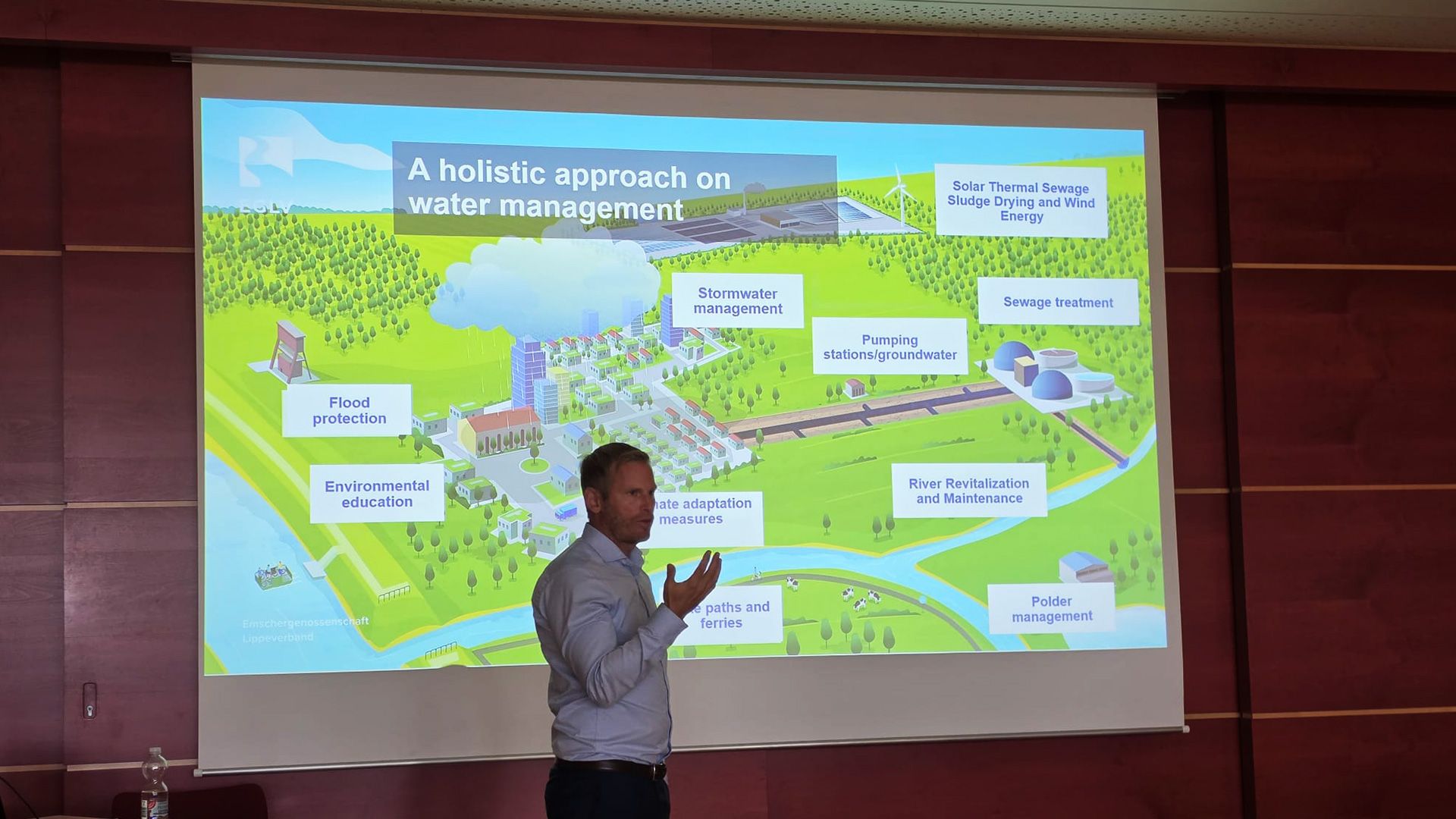
With AquaINFRA's final months now in view, project partners met in Bochum to plan how the work will be wrapped up, handed on and presented. The day combined planning sessions with a guest talk from one of Germany's most experienced water managers and a visit to the university's botanical garden.
The morning sessions looked ahead. Partners reviewed the plan for the remaining months of the project, agreed a structure for the training materials that will help others pick up and reuse AquaINFRA's tools and workflows, and began shaping the programme for the AquaINFRA final conference in Copenhagen.
Evaluation was also on the agenda. Rather than rely only on standard questionnaires, the team discussed more innovative ways of evaluating the project, and will try them out at the AquaINFRA webinar next week.
A river brought back: Dr Stephan Treuke on the Emscher and Lippe
In the afternoon, partners heard from Dr Stephan Treuke, Project Director of Emscherland, of the International Garden Exposition 2027 and of Emscher 2020 at Emschergenossenschaft and Lippeverband. Together, the two associations form Germany's largest water board and operate more wastewater treatment plants than any other organisation in the country.
The organisations have deep roots in the region. The Emschergenossenschaft was founded in 1899 as Germany's first water management association, and it became the model for the Lippeverband, founded in 1926. For much of the twentieth century, the Emscher served as an open wastewater channel for the Ruhr's mining and heavy industry. Over roughly 30 years, the Emschergenossenschaft invested around 5.5 billion euros in moving that wastewater into closed sewers and restoring the river and its tributaries to a near-natural state. It is one of the largest infrastructure projects in Europe.
Dr Treuke's presentation set out why this kind of work matters beyond engineering. Rivers can be a driving force for sustainable city development and for improving people's quality of life. Good rainwater and river management is central to climate change adaptation, and regional river governance offers a way to mediate conflicts over water use. The shift he described is from a purely functional use of rivers to a sustainable one.
That shift speaks directly to AquaINFRA's aims. The project is building the data infrastructure and workflows that help researchers and managers understand what is happening in rivers, lakes and coastal waters. The Emscher shows what can follow when that understanding is matched by long-term investment and regional cooperation. The discussion that followed gave partners a chance to exchange ideas and experience with someone who has seen a river restoration through at scale.
A visit to the Bochum Botanical Garden
The day ended with an excursion to the Botanical Garden of Ruhr University Bochum, a site of around 13 hectares. Dr Wolfgang Stuppy, the garden's Scientific Director, guided the group and gave partners an insight into the garden and its practical research activities.
.jpg&w=3840&q=75)
Botanical Garden of Ruhr University Bochum, photo by Sadra Matmir
What comes next
The next date in the diary is the AquaINFRA webinar next week, where the new evaluation methods will get their first outing. After that, attention turns to the training materials and the final conference in Copenhagen. Details of both will be shared here and on AquaINFRA's social channels.
Feature Image: Dr Stephan Treuke presents to AquaINFRA partners, photo by Sadra Matmir