


AquaINFRA News
Open-Access Data and SDMs for Danube Basin Freshwater Fish Habitat Modelling
November 19th, 2025

A recent open-access study by Basooma et al. (2025) introduces a novel tool designed to simplify access to ecological trait data for freshwater species, particularly from the www.freshwaterecology.info database. The research team led by BOKU University (Vienna) and partner institutes, developed an open-source R package called fwtraits. By combining this tool with comprehensive environmental datasets, they assessed where different fish species are most likely to thrive under current environmental conditions.
Full publication available here:
https://doi.org/10.1016/j.baae.2025.10.010
The study’s aims were threefold: to improve tool development, data accessibility, and reproducibility in freshwater biodiversity research, and to demonstrate European-wide basin level assessment of the changes in the community weighted means for European freshwater fish using open data sources and under varying climatic conditions .
Data and Modelling Approach
The usefulness of the package was demonstrated by assessing the changes in the community-weighted means of European freshwater fish community groups in response to changes in climatic conditions. Fish species abundance was retrieved from the RivFishTIME database (Comte et al., 2021). The climatic predictors were from the WORLDCLIM databases (https://www.worldclim.org; Fick & Hijmans, 2017). River basins were retrieved from the European Catchments and Rivers Network System (ECRINS) of the European Environmental Agency (EEA, 2012). Functional traits were retrieved from the www.freshwaterecology.info database using the fwtraits R package.
Results indicated that freshwater community groups, which are not resilient to climatic changes, such as stenothermals (fish species tolerant of narrow temperature ranges) or water column feeders community group, mainly dominated in the northern regions (Figure 2) (Basooma et al., 2025). This result is crucial in identifying critical habitats or refugia for threatened community groups, aiding in the design of their protection and conservation strategies. The tool offers a seamless way of data access from the databases and can be complemented by other related tools such as the R packages rtry and rfishbase.
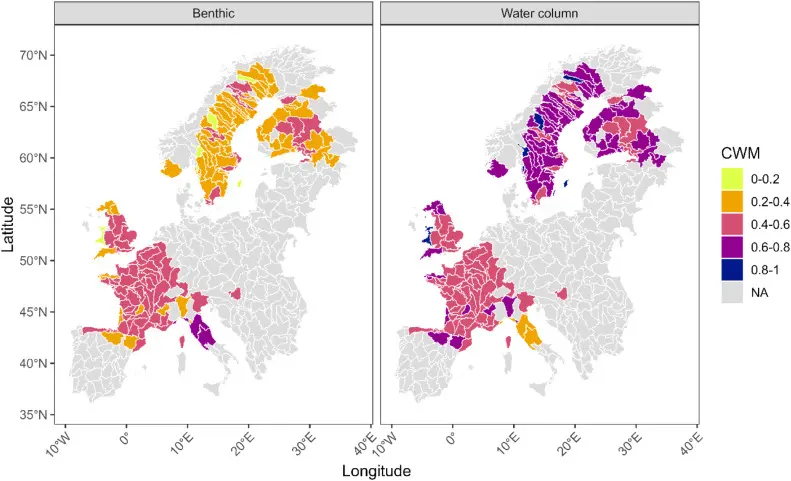
Figure. 2. CWMs for feeding habitat in European river catchments. The benthic group feeds near the stream bottom, and the water column group is a pelagic feeder. Grey-scale catchments had no species abundance. Blue and yellow had higher and lower CWM contributions, respectively (adapted from Basooma et al., 2025).
Significance and AquaINFRA Implications
The study highlights how open data and open tools can transform large-scale ecological modelling. By relying exclusively on publicly available datasets (for species, climate, and hydrology) and sharing all analytical code and outputs, Basooma et al. created a workflow that others can reproduce or adapt. Their new R package, fwtraits, provides a streamlined interface to freshwater species trait information, including ecological, functional, and life-history traits, making it easier to integrate biological meaning into biodiversity models.
This commitment to data transparency and interoperability aligns closely with the aims of the AquaINFRA project, which is building a Virtual Research Environment (VRE) and Data Discovery and Access System (DDAS) to enable scientists to work collaboratively across the marine and freshwater domains. AquaINFRA’s mission is to make environmental data FAIR: Findable, Accessible, Interoperable, and Reusable, and to connect inland water and marine data infrastructures across Europe.
By modelling fish habitat suitability across different international river systems, this study illustrates the benefits of cross-border, harmonised data for ecological analysis. Standardising data from multiple countries enabled the researchers to model the Danube as one integrated system, identifying areas that are most suitable for threatened fish species regardless of political boundaries. This basin-scale perspective is crucial for coordinated conservation planning and supports AquaINFRA’s objective of hydrosphere integration, connecting data and models from land, freshwater, and marine environments.
Finally, the authors’ emphasis on open and reproducible science including the release of R packages, modelling scripts, and cleaned datasets, reinforces AquaINFRA’s vision for transparent, high-quality research infrastructure. Their work demonstrates that when open-access data and interoperable tools are combined, scientists can generate trustworthy, reusable insights that accelerate collaborative progress across Europe’s aquatic research community.
Reference
Basooma, A., Borgwardt, F., Domisch, S., Buurman, M., Bremerich, V., Recinos Brizuela, S. S., Tschikof, M., Hein, T., & Schmidt-Kloiber, A. (2025). Introducing fwtraits – an R package for obtaining freshwater biodiversity trait information. Basic and Applied Ecology, 89, 81–91.
DOI: https://doi.org/10.1016/j.baae.2025.10.010
Comte, L., Carvajal‐Quintero, J., Tedesco, P. A., Giam, X., Brose, U., Erős, T., ... & Olden, J. D. (2021). RivFishTIME: A global database of fish time‐series to study global change ecology in riverine systems. Global Ecology and Biogeography, 30(1), 38-50.
Fick, S. E., & Hijmans, R. J. (2017). WorldClim 2: new 1‐km spatial resolution climate surfaces for global land areas. International journal of climatology, 37(12), 4302-4315.