


AquaINFRA News
Inside the EGU 2026 AquaINFRA Workshop: Running a Real Aquatic Workflow, Live
May 11th, 2026
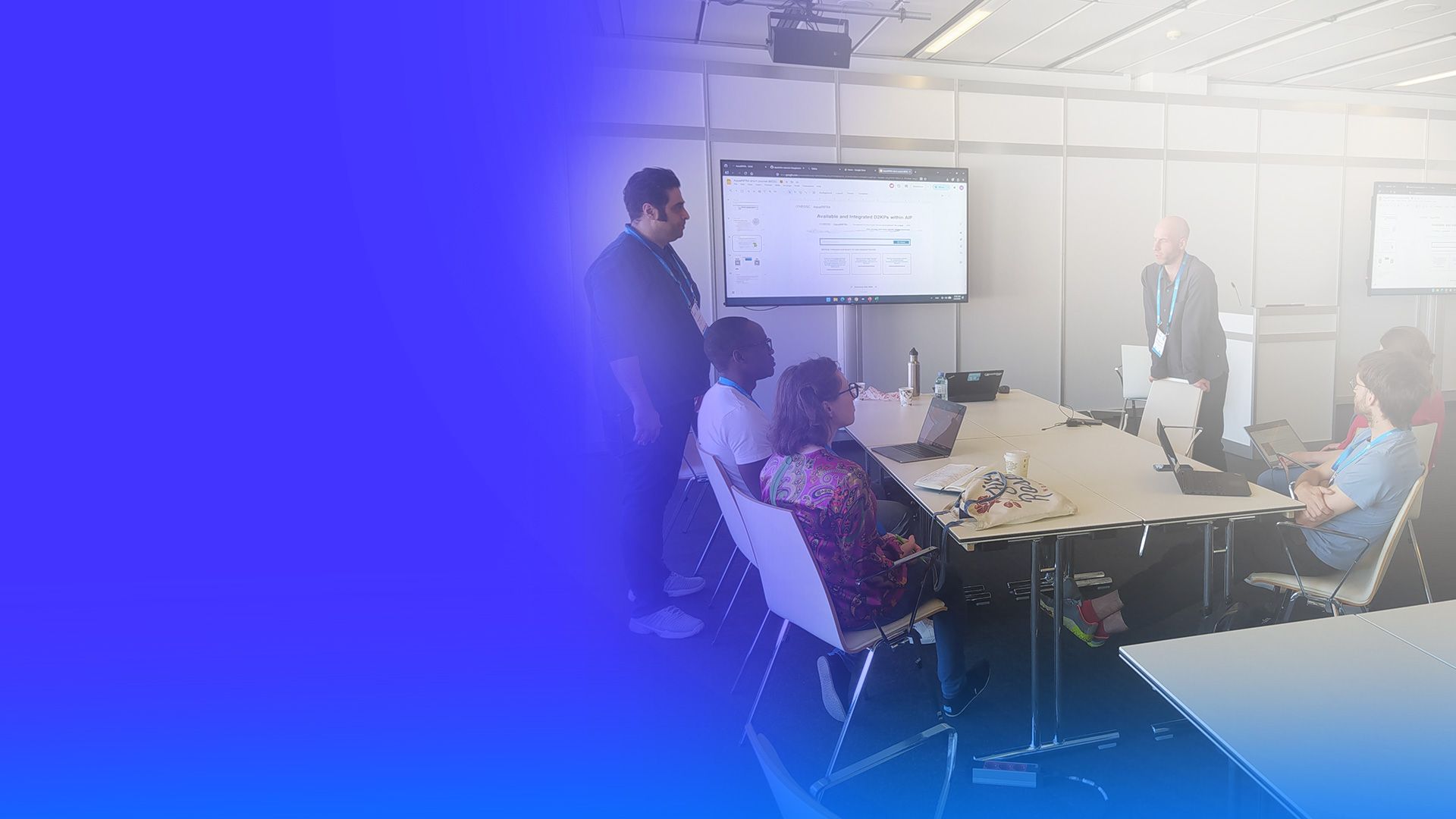
Last Friday at the EGU General Assembly 2026 in Vienna, AquaINFRA hosted a short course that took participants from a blank screen to a fully executed environmental analysis in a single session. The workshop introduced the AquaINFRA research infrastructure and then put it to work: attendees searched for FAIR aquatic datasets, imported them into Galaxy, and ran a reproducible R-based workflow examining long-term changes in water optical properties in the Gulf of Riga.
It was a hands-on session by design. Rather than describe what reproducible aquatic science could look like, the course asked participants to do it.
What the session covered
The course was presented by Markus Konkol and Sadra Matmir, and built around three connected ideas that sit at the centre of the AquaINFRA project:
- The AquaINFRA architecture, including the Interaction Platform that lets researchers discover and access FAIR aquatic datasets across marine and freshwater domains.
- Virtual Research Environments (VREs), in this case Galaxy, where users can chain analytical tools into reproducible workflows without needing to install software locally.
- Data-to-Knowledge Packages (D2K Packages), AquaINFRA's approach to bundling data, code, workflows, virtual lab environments, and web services into a single interoperable research package.
After a short introduction, participants moved straight into the platform. They searched the Interaction Platform for relevant datasets, brought them into Galaxy, and stepped through a complete computational workflow built around the Gulf of Riga hydrological use case.
The Gulf of Riga Data-to-Knowledge Package
The workflow centred on a single research question: do the optical properties of Gulf of Riga water change over the long term?
It is a useful question to demonstrate, because answering it cleanly requires the kind of integration that aquatic researchers usually have to assemble themselves. The Gulf of Riga D2K Package pulls together observational datasets (Secchi depth and water colour measurements), combines them with Baltic Sea subbasin information, performs temporal and spatial aggregation, runs Mann-Kendall trend analysis, and produces visualisations of the results. The full chain runs as a single reproducible workflow.
Participants did not just see the results. They executed each step themselves, which meant they could see exactly how the data moved from raw observation to interpreted trend, and which choices were made along the way.
Why a D2K Package matters
The concept of a Data-to-Knowledge Package is one of AquaINFRA's more distinctive contributions, and the workshop format gave participants a concrete way to understand it. A D2K Package is not just a dataset, and it is not just a script. It is a research object that combines:
- FAIR environmental datasets with persistent identifiers and machine-readable metadata,
- Reusable computational functions, in this case R-based,
- A complete workflow that orchestrates those functions,
- A virtual lab environment in which the workflow can be inspected and modified,
- Interoperable web API services that allow individual components to be reused outside the package.
For an external researcher, this means the Gulf of Riga analysis can be reproduced end-to-end, adapted to a different basin, or partially reused (for example, the Mann-Kendall component on a different dataset) without rebuilding the surrounding infrastructure.
That is the shift the workshop was designed to make tangible: from isolated scripts and downloads to shareable, transparent, modular research.
.jpg&w=3840&q=75)
What the room looked like
The session was highly interactive. Participants worked through the workflow alongside the presenters, raised questions in real time, and discussed how the same approach could be applied to their own research areas, from coastal eutrophication studies to inland water quality monitoring.
The level of engagement reflects something we hear often when researchers encounter AquaINFRA for the first time: the appetite for reproducible, integrated tooling in aquatic science is high, but the path from interest to adoption needs to be short. Workshops like this one are part of how AquaINFRA is shortening it.
Try it yourself
The Gulf of Riga D2K Package and the AquaINFRA Interaction Platform are openly available to the research community. Researchers who could not attend the EGU session can still explore the workflow, examine the underlying code in the virtual lab environment, or reuse individual components in their own studies.
If your research touches on aquatic data, whether marine, coastal, or freshwater, the same infrastructure is available to you. We would encourage you to try it, and to get in touch with the AquaINFRA team if you would like to discuss how a D2K Package might apply to your own use case.
The EGU 2026 short course "AquaINFRA: Reproducible Environmental Workflows with Virtual Research Environments and Data-to-Knowledge Packages" was presented by Markus Konkol and Sadra Matmir.